

Resilient by design – building cities to adapt through crisis
1st October 2025
Share this content


Authors: Prof Ashraf M Salama, University of Northumbria, UK; Dr Madhavi P Patil, University of Northumbria, UK; & Dr Laura Maclean, University of Strathclyde, UK
Prof Ashraf Salama, Dr Madhavi Patil and Dr Laura Maclean respond to the mission question from a European context, based on real-world evidence, lived experiences, and lessons learned from their investigation of cities on the frontlines of change.
How do you plan and design for a future that declines following the script? What if disruption isn’t the exception, but the norm? How do you plan a city when the rules fluctuate? When the world is hit with crisis after crisis including heatwaves, earthquakes, floods, pandemics, and also industrial crisis and economic shocks, how do cities grow stronger?
These questions are no longer imaginary. They represent the realities architects, urban design and planners, local governments, and communities, across Europe and globally, have been grappling with over the last decade. The old, rigid, and linear city planning models were based on stable assumptions but are now cracking under the pressure of a world in continuous flux.
Take a few moments to think back to March 2020 when the pandemic started and when within weeks, streets evacuated to emptiness, economies slowed to a crawl, and everyday habits were overturned.
Cities became vanguard respondents to a global health crisis they didn’t see coming. Scrambling to cope, local governments had to make rapid decisions, sometimes with limited data, often under intense pressure. Yet, amid the chaos, something remarkable happened: innovation, adaptation, and community-driven solutions emerged at a scale many have not imagined and a few have anticipated. Likewise, heatwaves, earthquakes, floods have instigated similar crisis situations, with challenges and opportunities.
This was the starting point for our study. And while crises may keep coming, they also invite us to rethink how we build, govern, and imagine the cities of tomorrow.
Our aims for the European cities study
During and post-crisis situations, we wanted to understand: What worked? What didn’t? And most importantly, what can we learn for the future? Because the reality is: the future will be marked by uncertainty, climate disruption, social change, economic volatility, and more. But within that uncertainty lies an opportunity: to reimagine how we build our cities from the ground up.
In our paper, Urban resilience and sustainability through and beyond crisis, we scrutinised how more than 20 European cities responded to the dual challenges of encountering crisis and long-term sustainability. We explored a set of cities that had experienced such entanglement, looking specifically at:
- How resilience and sustainability were understood by different urban stakeholders
- What types of governance practices emerged in response to crisis
- How data, monitoring, and evidence were used in decision-making
- What lessons could be drawn for future urban planning and crisis governance.
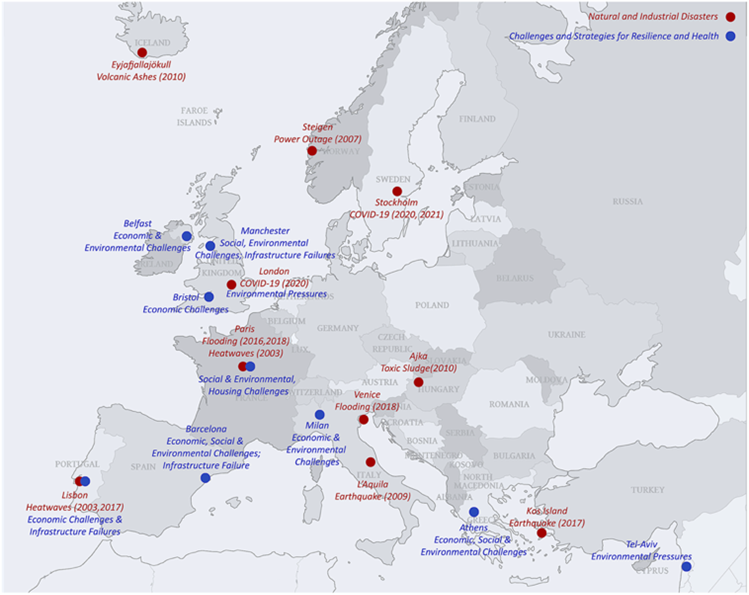
Cases of European cities identified to examine experiences of crisis situations and the related impacts and responses (red) and to scrutinise challenges and strategies for resilience and health (blue)
The study analysed how European cities have responded to and recovered from various forms of crisis – not just shocks or natural disasters, but longer-term stresses including public health challenges, political fragmentation and social inequality. Urban challenges rarely occur in isolation. Rather, we like to emphasise the notion of ‘crisis entanglement’, a city condition where multiple crises interact and impact or exacerbate one another.
The result is a cross-cutting analysis of cities learning to endure with uncertainty in systems that are often disintegrated, under-resourced, or politically contested.
Five missing conceptions and misconceptions on urban resilience
Our study unveils five recurring blind spots across different cities and urban contexts:
- Confusing normal for safe: Many cities entered crisis already carrying significant vulnerabilities, including weak public health systems, housing insecurity, and fragmented governance. Notably, the crisis didn’t create these; it exposed them. The misconception here is that resilience starts when a crisis begins and the missing conception is that resilience must be rooted in addressing ongoing systemic fragilities, not just preparing for the next disaster.
- Assuming resilience has one meaning: Some cities viewed resilience as hard infrastructure; others saw it as community strength or adaptive governance. The lack of shared understanding often leads to confusion and competing priorities. The misconception is that ‘resilience’ has a fixed, universal interpretation and the missing conception is that cities need inclusive, contextual discussions to clarify what resilience means for them, before trying to operationalise it at the local scale.
- Thinking collaboration is automatic and spontaneous: While collaboration surged during crisis, it was often informal and short-lived. Without formal mechanisms, partnerships quickly lost drive once the crisis passed. The misconception here is that collaboration is automatic in emergencies and the missing conception is that institutionalised cooperation is what makes adaptive capacity stick, not just good intentions in the heat of the moment.
- Believing data equals action: Most cities had plenty of data, but not all used it meaningfully. Siloed schemes and unclear objectives meant that evidence didn’t always inform decisions. The misconception here is that data automatically leads to better decisions and the missing conception is that resilience requires strategic and shared use of knowledge, with feedback loops for learning, adaptation, and course correction.
- Anticipating that crisis will drive change: Crises can create potentials for reform, but transformation rarely happens by accident. Without political will, trust, and capacity, the default is often to restore the old system. The misconception is that disruption will automatically lead to innovation, and the missing conception is that transformation is a deliberate, longer-term process, not something that emerges from necessity or urgency alone.
Why these missing conceptions and misconceptions matter? Because building resilience in the face of volatile futures requires not just new tools, but new ways of thinking about urban systems, governance, and collective responsibility.
Our findings suggest that the most resilient cities aren’t those that plan for one specific crisis. They are the ones that cultivate a mindset of adaptation, openness, and critical reflection, before, during, and after disruption.
Five takeaways and pathways
Recognising current gaps is a crucial first step. Because resilience isn’t just about bouncing back; it’s about seeing clearly, planning inclusively, and staying open to doing things differently.
We now conceptualise five things we learned a few years ago but they continue to echo today’s challenges:
- Resilience is institutionally cultivated, not bought: You can’t outsource resilience or commission it. It requires committed collaboration between local governments, central government, communities, and a wide spectrum of institutions. In all the cities we studied, partnerships between public authorities and grassroots organisations were key to effective crisis responses.
- Adaptability exceeds prediction: Instead of trying to forecast every possible future, the most successful cities embraced adaptive governance that allows for flexible decision-making, experimentation, and learning. Some cities showed how scenario planning and iterative strategies enabled better outcomes during crisis and beyond.
- Data is power, if you know how to use it: Many cities had access to data but struggled to integrate it into real-time decisions. The ones that made progress developed evidence-based monitoring systems to track vulnerability and recovery, turning information into prioritised actions.
- Equity is non-negotiable: Resilience without justice is socially fragile. Inequality exacerbated the impact of every crisis, from health outcomes to housing insecurity. Cities that prioritised social resilience to protect vulnerable groups during crisis coped better overall.
- Nature-based solutions are not greenwashing: Several cities used crises as an opportunity to scale up nature-based solutions, such as urban greening, sustainable mobility, and public space reallocation. These solutions addressed climate goals and improved mental health and social cohesion, aspects that are essential in times of stress.
What’s changed since we published our study?
Since we completed our study in 2022 and published it in 2023/24, the concept of ‘polycrisis’ has become more mainstream. Climate emergencies are accelerating, inflation is piercing, geopolitical tensions are rising, and migration is increasing. There’s also growing interest in localised resilience and sustainability. Instead of relying solely on national strategies, more city councils and municipalities are building their own resilience and sustainability plans, tailored to their unique social and environmental contexts. This bottom-up shift is crucial and overdue.
The cities examined in our study continue to adapt. Some have embraced green recovery strategies and integrated sustainability into broader sustainability and resilience agendas. Others are still struggling to keep momentum as political cycles shift, and new crises emerge at the centre stage.
But what is the biggest change?
There’s now a growing cognisance that business-as-usual is a disadvantage. A sustainable and resilient future won’t be built on yesterday’s logic or modes of thinking and decision-making.
What still needs to change?
Despite the progress made in many cities, there are still major gaps to address if we’re genuine about building sustainable and resilient structures and infrastructures that can endure an unpredictable future. We believe that cities need to:
- Break down silos: Integrate climate, health, housing, and mobility planning noting that resilience demands cross-sector thinking, not isolated divisions or responsibilities.
- Invest more in people and less in projects: Infrastructure is important, but social infrastructure, relationships, trust, civic participation, local capacity, is just as fundamental.
- Reorient pilot projects to systemic change: Move beyond one-off pilots. Embed successful initiatives into broader systems, backed by long-term political and financial support.
- Redefine risk and success: Encourage and reward experimentation. Accept that learning, from both successes and failures, is key to long-term transformation.
Building hope and flexibility into our cities – a call to action
Now, can we build a future we can’t predict?
We trust the answer is yes, but only if we start designing with uncertainty in mind.
But what does this mean?
It means departing from the misconception of control and leaning into flexibility, through resilience thinking, adaptive planning, nature-based solutions, and systems that can learn and evolve. Think of it like tending a garden: you can’t control the weather, but you can create the conditions for growth, adapt to the seasons, and complement nature rather than compete with it. This is a shared responsibility, not limited to policy makers. Researchers need to go beyond theory and envision and test real-world solutions. Planners must ask whether our institutions are built to adapt. And, as citizens, we all have a part to play in our neighbourhoods, communities, and everyday choices.
The future may be uncertain but how we face it is entirely up to us.
“Resilience isn’t just about bouncing back; it’s about seeing clearly, planning inclusively, and staying open to doing things differently”
Want to Learn More? Whether you're a policymaker, urban designer, or curious citizen, we hope our paper Urban resilience and sustainability through and beyond crisis stimulates ideas and hopefully triggers actions.
Authors
(Left to right)
- Prof Ashraf M Salama, Professor of Architecture and Urbanism and Head of School of Architecture and Built Environment (SABE), University of Northumbria, UK.
- Dr Madhavi P Patil, Lecturer in Built Environment, School of Architecture and Built Environment (SABE), University of Northumbria, UK.
- Dr Laura Maclean, Research Associate, Department of Design, Manufacturing and Engineering Management (DMEM) / Design HOPES, University of Strathclyde, Glasgow, UK.




Sustainable structures and infrastructures
We are passionate about supporting researchers, policymakers, and practitioners in their efforts to minimise the environmental impact of structures and infrastructures.
Would you like to talk to someone about our ICE Publishing products?
To find out more about getting access to our ICE Publishing products, please fill in the form and one of our team will get in touch with you.
You can also use the form to recommend this product to your budget-holder or librarian if you are not the budget holder yourself.
Share this content