

Billionaires and climate change
20th August 2025
Share this content


Author: Dr. Karen Cripps, Oxford Brookes University Business School, United Kingdom
With oversized feet, Izan Zareski’s ‘Big Foot’ family sculptures (Zareski, n.d.), symbolise human connection to the planet through shared experiences, seeking to inspire unity and environmental consciousness across generations. The oversized feet might also be taken to represent the outsized carbon footprint associated with billionaire lifestyles and the unequal power and influence that come with unfettered wealth.

Big Foot Sculpture – Royal Hillsborough Forest, Belfast, Northern Ireland (Author’s photo)
The global non-governmental organisation, Oxfam, has run several campaigns highlighting how climate inequality is magnified by the ‘super-rich’ and that the world’s richest 1% “burn through their entire annual carbon limit in just 10 days” (Oxfam, 2025). Billionaires’ higher carbon emissions are typically associated with lifestyle consumption and travel choices, but also through financial investments, and influence on media/policy. The concentration of wealth means that the global ‘carbon budget’ to keep temperature increase limits of 1.5 °C or 2.0 °C will be spent by a small share of humanity (Gössling & Humpe, 2023).
Carbon inequality – a need to redirect private financial investment flows?
Public finance is unlikely to be sufficient to address climate change; therefore, private finance is vitally important. However, billionaires’ financial investments (Schöngart et al., 2025) include high emissions sectors such as the fossil fuel industries, now being actively encouraged in the US. The International Energy Agency (IEA)’ s director recently indicated a reversal on slowing fossil fuel investment as necessary to meet global energy demands (Costa, 2025). While investors in fossil fuels might be encouraged to leverage resources and expertise to accelerate climate action (IHLEG, 2024), this depends on investor climate awareness and their ability to influence powerful vested interests. More action is therefore needed on ‘levelling mechanisms’ to reduce inequalities, such as ‘shaming campaigns’ that lead to cutting footprints or divestments (Barros & Wilk, 2021).
‘AI for environment’ – what billionaires really need to do.
The potential for AI to contribute to emissions reduction is argued to be substantial in a climate transition (Stern et al., 2025) and the global race to invest is seriously underway. AI projects are widely reported to drive a reduction in carbon emissions, although increasing concerns are surfacing over data centre energy and water use. However, such concerns are rarely discussed in the public media, which is often owned by billionaire families. The ‘Enabled Emissions Campaign’ (2025) draws attention to the climate pledges of tech giants such as Microsoft, Google, and Amazon, which are helping the oil and gas industry utilise AI technologies to drill more. Will corporate and media giants, with billionaire shareholders, focus on the positive aspects of AI growth to ‘offset’ data centre emissions? Will the wealthy elite attempt to ‘shame’ climate advocates who speak out, as seen in the response of Elon Musk to an activist who spoke out about electric vehicles and was vilified as a so-called ‘communist’ in a social media meme (Hogan, 2024). 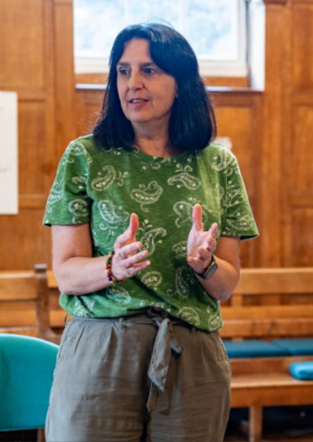
Returning to ‘Big Foot’ calls for ‘big’ action. Imagine what is possible if the consumption and investment decisions of the world’s wealthiest were more aligned with climate science. Campaigns such as 'Enabled Emissions' as a way to make all voices heard. Whether we do or don’t support the existence of billionaires, we can surely all agree on the transformative potential of climate-literate decision-making and behavioural choices by the world’s wealthiest – and keep up the pressure for system change.
Dr Karen Cripps is a Senior Lecturer in Responsible Management and Leadership at Oxford Brookes University Business School (UK). As a committee member of the Working Group on Climate Change and Environment for the UN-supported initiative ‘Principles of Responsible Management Education’ (PRME), she facilitates climate literacy training and a mentoring programme. Karen is co-editor of the book ‘Higher Education and SDG 2: Zero Hunger’[1].
References
Barros, B., & Wilk, R. (2021). The outsized carbon footprints of the super-rich Sustainability: Science, Practice and Policy 17, 316-322.
Costa, M. (2025). IEA head says fossil fuel investment needed, despite agency's own research
Enabled Emissions. (2025). Enabled Emissions Campaign
Gössling, S., & Humpe, A. (2023). Millionaire spending incompatible with 1.5 °C ambitions Cleaner Production Letters 4.
Hogan, C. (2024). Elon Musk turned me into a meme.
IHLEG. (2024). Raising ambition and accelerating delivery of climate finance: Third report of the Independent High-Level Expert Group on Climate Finance
Zareski, I. (n.d.) Accessed online July 22, 2025
Oxfam. (2025). Richest 1% burn through their entire annual carbon limit in just 10 days
Schöngart, S., Nicholls, Z., Hoffmann, R., Pelz, S., & Schleussner, C. (2025). High-income groups disproportionately contribute to climate extremes worldwide. Nature Climate Change 15, 627-633.
Stern, N., Romani, M., Pierfederici, R., Braun, M., Barraclough, D., Lingeswaran, S., Weirich-Beneet, E., & Niemann, N. (2025). Green and intelligent: the role of AI in the climate transition Nature 4.
[1] Higher Education and SDG 2: Zero Hunger

Fairer society
We are passionate about working with researchers globally to deliver a fairer, more inclusive society. This perhaps has never been more important than in today’s divided world.
Share this content