
Share this content


Author: Azhar Amir - professional writer who has worked for organizations such as UNDP, FAO, UNODC, and UNICEF
Why we need multifunctional landscapes
Historic land-use practices (Intensification and enlargement of farming) have dramatically changed the agricultural landscape across the world, limiting opportunities for humans and wildlife. Multifunctional landscapes provide many ecosystem services such as (regulating, supporting, and cultural) and have great socio, economic and ecological value e.g. Pollination is critical for the maintenance, the functioning of the ecosystem, and its value is derived from its contribution as well as its impact on agriculture. The need for multifunctional landscapes have been recognized by policymakers e.g. The Organization for Economic Co-operation and Development (OECD), Food and Agriculture Organization of the United Nations (FAO) and under European Union Agri environmental scheme field margins management is considered as a primary tool to promote biodiversity.
Multifunctional Field Margins (MFFM) are one of the most widely adopted conservation measures on farmland and are the key component of agriculture landscapes. MFFM benefits are multifold, they not only provide semi-natural habitat for biodiversity (e.g. pollinators for the crops and predators pests) but also reduce the effects of runoff and soil erosion. MFFM are also used for nesting, feeding, foraging for migration and movement of different species.
MFFM role in erosion prevention & maintenance of soil quality
Soil erosion is a prevalent problem in agricultural landscapes, predominantly in areas with strong rainfall events. In recent years’ soil erosion has been increasing and causing a severe reduction in agricultural productivity. Extreme weather (e.g. floods and rains) along with human actions cause water erosion that produces severe problems in agricultural landscapes (e.g. sedimentation of fields in downstream and water bodies which as a result affects water quality, alone in Asia water erosion is responsible 59% of total land degradation.Principally
soil erosion (controlling and prevention) can be achieved by reducing surface flow and several methods exist for this e.g. crop rotation and tillage practices within the field, using vegetated field margins to improve soil stability which in turn helps soil erosion control.
Vegetated field margins are a crucial factor averting soil erosion by trapping eroded material. Several studies have shown that MFFM contribution in offsite sediment retention is between 70% to 90% and vegetation of MFFM reduces sediment loads to streams and rivers. A similar study conducted by Heede (1990) on vegetated buffer strips showed that vegetated buffer strips trapped 61 times than sites without buffer strips.
MFFM & pollinators
One of the major benefit of the MFFM is the pollination services they provide for the crops. The economic value of pollination services provided by the insect pollinators (mainly bees) is estimated around €153 billion that amounted to 9.5% of total world agriculture food production (TEEB, 2010; Settele et al., 2008; FAO, 2006).
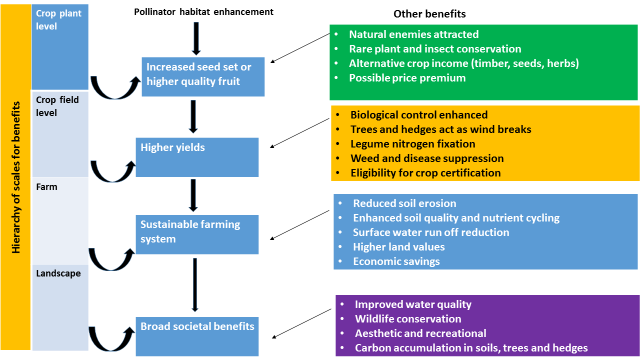
According to European Crop Protection (ECP), Globally 264 crop species have been identified that depend (fully or partially) on pollination. In pollinator management, best practices occur at various levels and scales i.e. field, farm, and landscape. Figure 1 explains the benefits of pollinator enhancement at a different level.
The pollinated crops are also a major source of micronutrients like Vitamins (A, C) calcium, and iron. These services are most important to address the nutritional security of the poor globally (Bharucha and Pretty 2010; IUCN, 2013).
Figure 1: Hierarchy of scales for potential benefits of pollinator habitat enhancement
Source: Adopted from Wratten et al. (2012)
Concluding remarks
Benefit derived from multifunctional landscapes (economic and services to sustain life) are more than the value of converted land. However, despite MFFM importance, in policy and decision making MFFM benefits, are often not fully taken into consideration therefore landscapes continuously being converted into single land use e.g. crops.
Given the current and future challenges to our food security and environment, it is important to assess and measure the multiple benefits of MFFM in order to take a more balanced approach regarding tradeoffs involved in the use of landscapes and to promote sustainable agricultural practices on farmland. Multifunctional landscapes use can help to achieve ecological sustainability, food security and increased agriculture production through pollinators services.
References:
Bharucha, Z. & Jules Pretty, J. (2020): The roles and values of wild foods in agricultural systems.
Gallai, N., Salles, J. M., Settele, J., Vaissière, B. E. (2008). Economic valuation of the vulnerability of world agriculture confronted with pollinator decline. Ecological Economics. doi:10.1016/j.ecolecon.2008.06.014.
Hackett, M. & Lawrence, A. (2014). Multifunctional role of field margins in arable farming.
Share this content