

Responsible management:
The key to zero hunger?

An Emerald mission in support of the UN Sustainable Development Goals
Share this content


Despite an advanced global food system, millions still go hungry, highlighting the need for responsible management in all areas of food systems.
The calls come far and wide to underscore the urgency from the late Pope Francis to regional farmers. Food sovereignty isn't just a buzzword; it's a necessity. Structural flaws in economic policies, climate change, poverty, and political instability worsen food insecurity, particularly for marginalised communities.
Responsible management practices, integrating sustainable and inclusive approaches, are crucial. Empowering local communities through food sovereignty can be the key to sustainable, long-term solutions. We must transform our food systems to be globally smart.
How do we ensure responsible management at every level so that we can secure a just future for all?
To help us address this, in our mission we ask:
- What structural flaws in our global economic policies and responsible management practices perpetuate food insecurity and unequal access to resources?
- How does the intersection of climate change, poverty, and political instability exacerbate the hunger crisis, disproportionately affecting marginalised communities?
- Can empowering local communities through food sovereignty initiatives be the key to creating sustainable, long-term solutions to global hunger?
We invite you to join the discussion. If you have related research or insights that begin to address these questions, or the broader challenges within this area, then we’d love to hear from you! Get in touch today.
This mission supports our Responsible management goal
Learn more about our mission
Watch this video overview from Goal Advisor Richard Oloruntoba to find out more about the focus of our mission and the need for responsible management practices across all areas of food systems in addressing the global challenge of food insecurity and creating a just future for all.
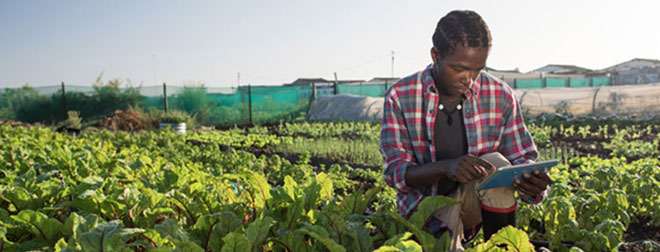
Author insights
Take a look at our latest blogs and podcast episodes to find out more about what our authors have to say on this topic.






Podcast
Rethinking our role: from consumer to food citizen
Listen to this Emerald Podcast Series episode as we speak with leading food systems and policy experts Professor Sima Hamadeh and Dr Christian Reynolds to explore the difference between food citizens and food consumers, the role of food literacy in shaping food choices, and the ways in which food citizenship connects to wider issues such as public health, sustainability and policy.
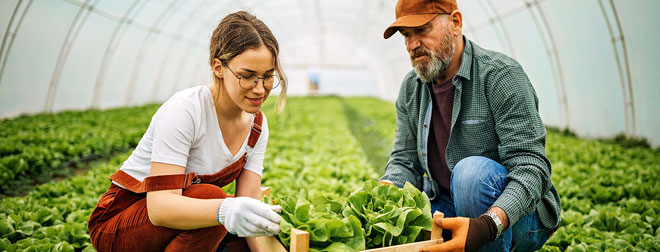
Different routes to publication
Take a look at our calls for papers, special issues, books, cases and featured journals that showcase further research and publishing opportunities within this area.


Featured journals
Here we have highlighted our key journals that publish research articles in this area. You can also search for a specific journal by subject area on our find a journal page.
If you want to speak to us about publishing an article in one of our journals, please get in touch.
Journal of Responsible Production and Consumption
British Food Journal
Supply Chain Management: An International Journal
China Agricultural Economic Review
Journal of International Trade Law and Policy
The International Journal of Logistics Management
Journal of Agribusiness in Developing and Emerging Economies
International Journal of Migration, Health and Social Care
Safer Communities
 Our new Open Access journal: Global smart food systems
Joining our new collection of Gold Open Access journals, Global smart food systems (GSFS) delves into the intricate web of food systems worldwide, and welcomes research submissions that explore traditional, modern, and mixed food systems by analysing their interplay with economic, social, environmental and health systems.
The article processing charge (APC) will be waived for all manuscripts submitted before 31st October 2025.
Find out more about the journal and submit your related research here

Additional information
Getting your food systems research published
Watch the recording from our recent webinar in partnership with STFC Food Network+ as the Editors of British Food Journal, Journal of Responsible Production and Consumption, and the Global Smart Food Systems journal share guidance and insights about how to publish your work and how to give yourself the best chance of your article being accepted.
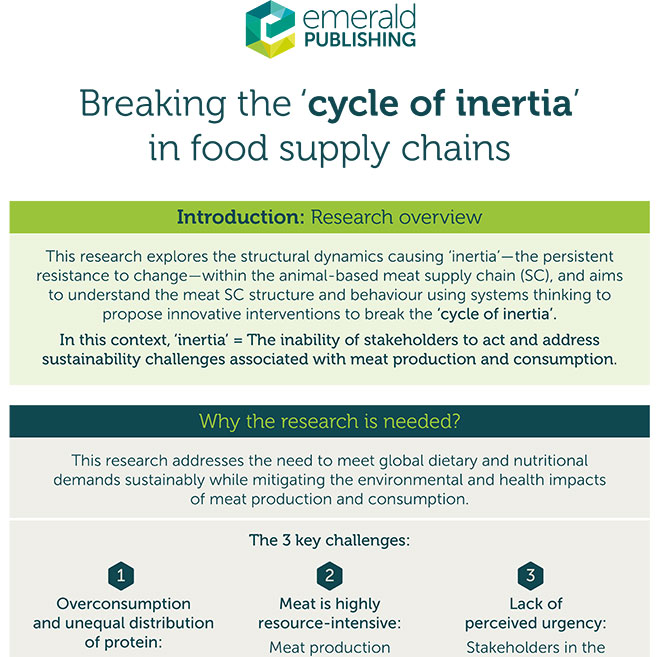
Breaking the ‘cycle of inertia’ in food supply chains
Take a look at this infographic that explores the structural dynamics causing ‘inertia' - the persistent resistance to change - within the animal-based meat supply chain (SC), and aims to understand the meat SC structure and behaviour using systems thinking to propose innovative interventions to break the ‘cycle of inertia’.
View the infographic to find out more
Article: Breaking the cycle of inertia in food supply chains: a systems thinking approach for innovation and sustainability
Journal: Supply Chain Management
Breaking the ‘cycle of inertia’ in food supply chains
Introduction: Research overview
This research explores the structural dynamics causing ‘inertia’—the persistent resistance to change—within the animal-based meat supply chain (SC), and aims to understand the meat SC structure and behaviour using systems thinking to propose innovative interventions to break the ‘cycle of inertia’.
In this context, ‘inertia’ = The inability of stakeholders to act and address sustainability challenges associated with meat production and consumption.
Why the research is needed?
This research addresses the need to meet global dietary and nutritional demands sustainably while mitigating the environmental and health impacts of meat production and consumption.
The 3 key challenges:
1) Overconsumption and unequal distribution of protein: Global protein consumption exceeds the average daily requirement of 50g per capita (with significant inequalities across regions).
2) Meat is highly resource-intensive: Meat production challenges the ability to achieve the UN SDGs, particularly SDG1, SDG2, SDG3, SDG6, and SDG13.
3) Lack of perceived urgency: Stakeholders in the food SC show a ‘lack of urgency’ in addressing the ‘diet-environment-health’ trilemma to avoid potential public and industry repercussions.
Systems-level innovative interventions are needed to break the ‘cycle of inertia’ in meat SCs and facilitate the transition towards a sustainable and resilient food system.
Research questions
1) What underlining meat SC system structure and interlinkages lead to the emergence of the ‘cycle of inertia’?
2) How to efficiently and innovatively intervene in meat SC systems to mitigate the associated sustainability ramifications?
Methodology
This study involves a three-phase approach to understand the meat SC system and inspire innovative interventions for sustainability.
Data was collected through literature synthesis, expert interviews, and a focus group.
Phase 1: Conceptual framework development
- Identified system structure and conceptualised intervention strategies.
- Review of existing literature to determine key drivers and impacts of meat production and consumption.
- Interconnections were explored to uncover drivers of ‘inertia.’
Phase 2: Data collection and analysis
- 12 expert interviews were conducted across industry, academia, government, and NGOs.
- Data analysis informed the system structure and intervention strategies.
- Causal loop diagrams were used to map variables, parameters, and their structural interrelations and feedback mechanisms to validate system dynamics.
Phase 3: Model structure refinement
- A unified framework of innovative intervention strategies was proposed for breaking the ‘cycle of inertia’ and to mitigate negative impacts of meat production and consumption.
Results
The underlying structure of the meat food system reveals 6 key subsystems that dictate the ‘cycle of inertia’ preventing sustainability:
- Social
- Institutional
- Value chain
- Cultural
- Economic
- Environmental
Reducing the sustainability impact of meat is a complex problem due to the imbalance between reinforcing loops (26) and balancing loops (14). Delays in balancing loops lead to low awareness of sustainability challenges, contributing to the ‘cycle of inertia.’
The proposed system model motivated 6 innovative strategies for intervention by governments, public bodies, NGOs, industry, academia, and civil society, categorised into 3 main action stages:
1) Engaging or ‘Getting people involved’
2) Encouraging or ‘Giving the right signals’
3) Enabling or ‘Making it easier’
Adopting these strategies according to scale and context can help break the ‘cycle of inertia.’
Conclusion
By exposing the structural drivers of inaction and proposing strategic leverage points, the study empowers policymakers, industry leaders, and civil society to initiate a transition towards a sustainable and resilient food future.
Talk to us about your work
We love hearing from researchers and practitioners about their work.
If you would like to contribute to the discussion, or have supporting research that addresses the challenges in this area, please let us know by filling in this form.





Share this content